How to Read Your Puppy's "I Need to Go" Signals
Circling, sniffing, sudden silence, heading toward a corner. Learn the signals before the accident happens.
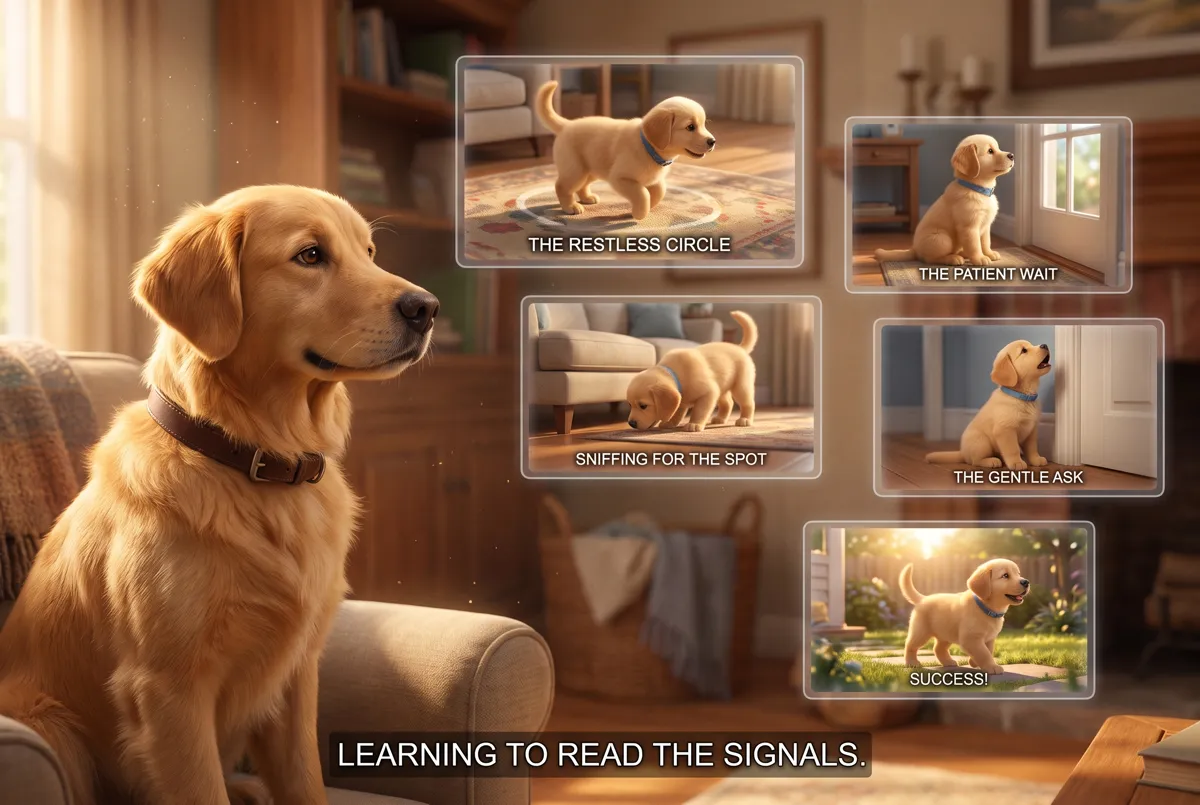
Most potty training advice focuses on schedules and reward systems. But there's a skill that matters even more: learning to read your puppy. He's telling you he needs to go every single time. You just haven't learned his language yet.
Dogs don't come with an instruction manual, but they do come with a pretty consistent set of behaviors that mean "I need to go outside right now." The earlier you can spot them, the more accidents you can prevent — and every prevented accident is one step closer to being fully house-trained.
The six most common signals
1. Circling
This is the classic one. Your puppy starts walking in tight circles, nose to the floor, like he's looking for something. He is — he's looking for the right spot to go. In the wild, dogs circle to flatten grass and check for predators before eliminating. Your living room carpet triggers the same instinct. When you see circling, grab him and head outside. Immediately.
2. Sniffing intensely
Dogs experience the world through their nose. When a puppy starts sniffing the floor with unusual intensity — not the casual "what's this smell" sniff, but focused, deliberate, head-down sniffing — he's searching for a place to go. If he's already had accidents in the house, he might be sniffing out the spot where he went before, because dogs tend to return to the same place if the scent is still there.
3. Sudden silence
This one is easy to miss, but it's one of the most reliable signals. If your puppy was just running around playing, and then suddenly he goes quiet and disappears — that's not "he's found a toy to chew on." That's "he's found a private corner to have an accident." If your noisy puppy goes silent, go find him. Nine times out of ten, he's up to something.
4. Heading toward a door or a specific corner
Once a puppy starts to figure out that outside is the right place, he'll start trying to get there. If he walks toward the door, scratches at it, stares at it, or paces by it — that's him saying "let me out." Same thing if he heads toward the same corner of the room every time — he's picked a "bathroom spot" in his head.
5. Whining or restlessness
Some puppies will vocalize when they need to go. It might be a soft whine, a little bark, or just a general sense of "I'm uncomfortable and I don't know why." If your puppy is fidgeting, can't settle, and keeps getting up and sitting back down, that's a good sign he needs to go out.
6. Squatting or lifting a leg
This is the last signal, and by the time you see it, it's probably already too late. But if you catch him mid-squat, you can still scoop him up and get him outside. The key is to catch the earlier signals so you never get to this point.
How to respond when you see a signal
When you spot one of these signals, don't say anything. Don't yell, don't call his name, don't react dramatically. Just calmly pick him up or gently herd him toward the door. Getting excited or loud can make him forget why he needed to go in the first place, or worse, make him afraid to show you signals next time.
Once you get outside, wait. Give him a minute or two. When he goes, praise him immediately and give him a treat. You want him to connect the dots: "when I feel this feeling, I should go to the door, and then when I go outside, good things happen."
The goal isn't to catch every accident. The goal is to learn his signals well enough that accidents become rare.
Why some signals are easy to miss
The biggest mistake new owners make is assuming their puppy will communicate the same way a human would. We go to the door and knock or wait. A puppy might just sit there and stare. We ask "do you need to go out?" — a puppy doesn't understand the question, and even if he did, he can't answer in words.
You have to meet him halfway. Watch what he does. Learn his patterns. Notice the small changes in his behavior. The signals are there. You just have to learn to see them.
And remember — even when you miss a signal and there's an accident, it's not his fault. He didn't know how to tell you clearly enough, or you didn't see it. Either way, the solution is the same: keep watching, keep learning each other, and stay consistent with the routine.
Want a clear, step-by-step potty training routine?
The publisher advertises a seven-day guide focused on signals, timing, and consistency. We summarize the offer and its limits.
Read the offer overviewThe overview contains affiliate links · We may earn a commission